A guy walked into my Nashville fitting room last fall with a navy suit still in the bag and a dead simple question: can this cover work, a wedding, and two events he did not want to buy clothes for? That is the real promise behind men's suit one way five. Not magic. Just one suit that earns its keep because the fit is right, the fabric is useful, and the color does more than sit in the closet.
I've seen this on about 5,000 men, and the fix is almost always the same. Most guys do not need a bigger wardrobe. They need one suit that looks sharp at 9 a.m., does not fight them at 4 p.m., and still feels right at dinner. Fit first. The rest is noise.
How men's suit one way five works in a real closet
If you strip away the marketing, men's suit one way five just means a suit with enough range to cover the boring life stuff and the rare stuff. That usually means work presentations, weddings, funerals, interviews, date nights, and any event where jeans would feel lazy. The trick is not buying the fanciest suit in the store. It is buying the most adaptable one.
Start with navy or medium gray before you touch black. Black reads formal fast, and on most guys it can look harsh unless the fabric and shirt are doing a lot of work. Navy is the safer buy because it plays well with white shirts, light blue shirts, knit polos, and even a clean T-shirt if the setting is casual enough. Medium gray is the other strong option because it looks calm, not corporate. If your life is mostly office, church, and one or two weddings a year, that is where I would send you first.
As for fabric, wool does the heavy lifting. A plain wool or wool blend suit breathes better, wrinkles less than cheap shiny fabric, and hangs better after a long day in the car or at a desk. You do not need a luxury label to get there. A decent off-the-rack suit from Bonobos, J.Crew, SuitSupply, Brooks Brothers, or Spier & Mackay often lands somewhere between $350 and $900 before alterations, and that is a useful lane for most buyers.
Start with the fit, because tailoring is cheaper than regret
Here is what is actually happening with a bad suit: the jacket is too boxy, the sleeves cover the shirt cuff, the pants stack up like a crumpled receipt, and the whole thing makes a normal body look like it was dressed in a hurry. That is not a body problem. That is a fit problem.
The jacket should hug the shoulders without pulling, close cleanly at the button, and let you slide a hand inside without swimming in it. The sleeve should show a quarter to a half inch of shirt cuff. The pants should skim the leg, not choke it. If the rise is too low, the jacket will ride up when you sit. If the legs are too wide, the suit loses shape before lunch.
Tailoring fixes a lot of this for less money than people think. A jacket waist take-in might run $25 to $60. Sleeve shortening can be $25 to $75. Trouser hemming usually lands around $20 to $40, and a taper can run another $25 to $60. That is why I tell guys to buy the best fit they can afford in the shoulders and chest, then let the tailor clean up the rest. You cannot tailor your way out of bad shoulders, but you can absolutely rescue a decent suit that was just a little off.
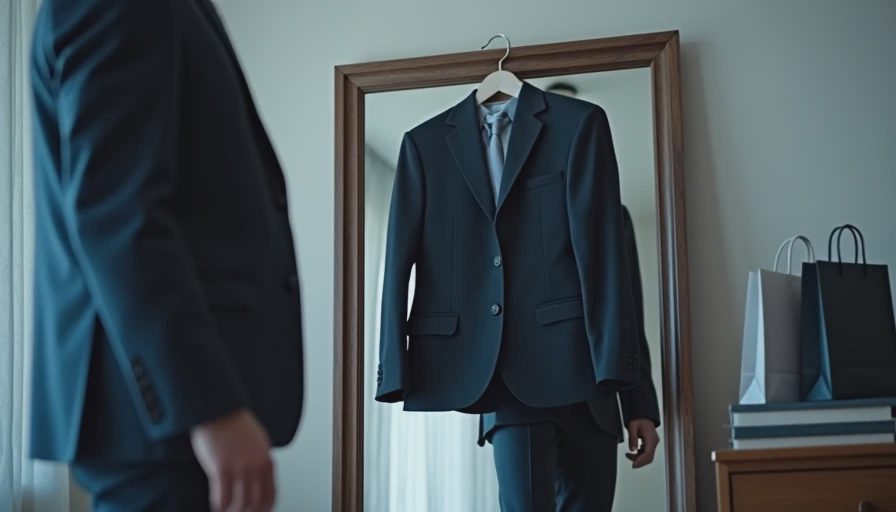
Choose fabric and color that can cover five situations
When I say men's suit one way five, I mean a suit that can move through five different rooms without looking lost. Navy wool does that better than almost anything else. It handles the office without feeling stiff, works for weddings without looking like you borrowed it, and still looks decent if you take the tie off.
Medium gray comes next because it is quiet in a good way. It lets your shirt and tie do some work, which is helpful if you already own a lot of white and blue shirts. Charcoal is stronger and a little more formal. If you want one suit for a more conservative office or a service job where you need to look buttoned up, charcoal is smart. I would still tell most guys to buy navy first unless their closet is already full of blue.
Pattern matters too. A solid suit is easiest to reuse. A subtle texture, like a bird's-eye weave or a faint herringbone, adds depth without locking you into one mood. Loud pinstripes are a different animal. They can look great, but they narrow the use case fast. The whole point here is range.
The five moments one suit has to survive
The best test is not how the suit looks on the hanger. It is how it behaves in real life. Can you sit through a two-hour meeting and still stand up with the jacket laying right? Can you wear it to a wedding in August without melting? Can you take the tie off and still look intentional at a nice restaurant? Can you wear it with clean sneakers for a less formal event if the dress code is loose? Can you keep it looking good after one long day and not feel like you need to go home and change immediately?
If the answer is yes, you are close. If the suit only works with a perfect dress shirt, a perfect tie, and a room full of people dressed exactly the same, it is too fragile for this assignment. A useful suit should adapt to your actual week, not just your best photo.
What to spend before you hand it to the tailor
A good rule is to put more money into the jacket and fabric than into a flashy label. Around $400 to $700 is a strong sweet spot for a first serious suit if you shop well. Below that, you can still find serviceable options, but the fabric, shoulder structure, and lining often get cheaper faster than people expect. Above $1,000, you are paying for nicer cloth, cleaner construction, or a more specific fit story, not just a better-looking color.
If you are buying one suit to do a lot of jobs, spend enough that the cloth drapes well and the jacket has real shape. Then budget another $75 to $150 for alterations. That money usually buys more improvement than jumping one price tier. I have watched guys walk out of the fitting room looking like they spent twice as much, and it almost always came down to sleeves, hem, and waist suppression.
A quick buying checklist before you swipe your card
Before you buy, check the shoulders first, because those are the hardest thing to fix. Then check the chest and button stance so the jacket closes without strain. Look at the lapel width and make sure it matches your build; wider chests usually handle a slightly stronger lapel better than a skinny one. Put your hands in your pockets and sit down. If the jacket turns into a straightjacket, keep looking.
Then picture where you will actually wear it. If the answer is work, weddings, and one funeral you hope stays on the calendar for a long time, navy or gray wool is the smart move. If you already own a decent suit and just need one that works harder, fix the fit before you buy a second one. That is the whole game. One suit, enough range, no drama. That is men's suit one way five done the right way.

No letters yet — pray write the first.